
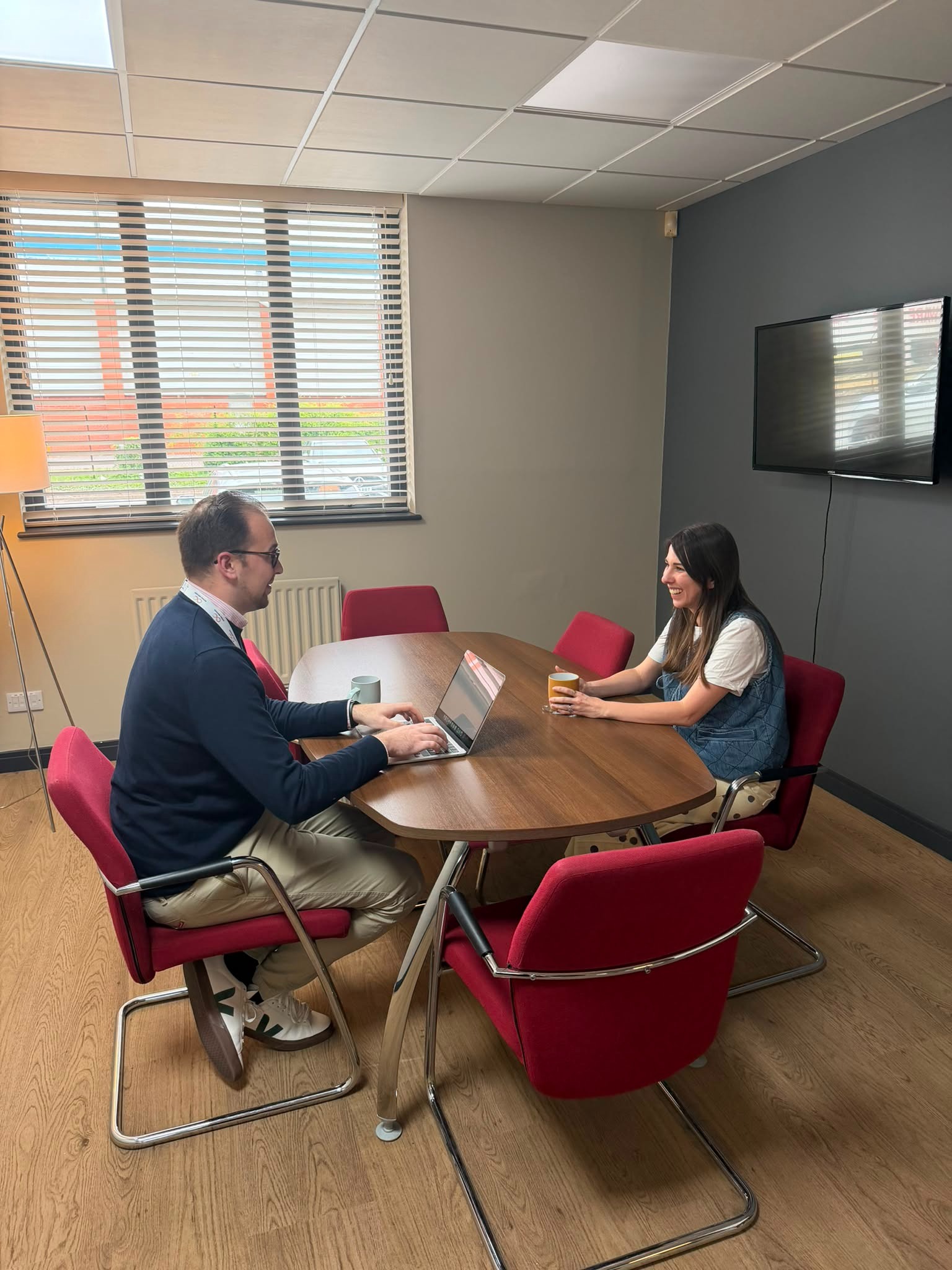
Cognitive assessments for Adults and children
A cognitive assessment explores how a person learns, thinks, remembers, and solves problems. It helps identify strengths and areas where support may be beneficial, providing practical recommendations to help individuals thrive at school, work, and in everyday life.

5-Star Rated On
What is a cognitive assessment?
A cognitive assessment is a set of standardised tasks that help us to identify strengths and difficulties in different areas.
The assessment also provides Full Scale Intelligence Quotient as a standardised measure of overall intellectual ability.
We don't see diagnosis as the end point - ongoing support is a core part of what we offer through our peer support program, ensuring you have guidance, resources, and continuity of care after your assessment.
Depending on age, we use well-established, evidence-based tools:
For children and young people, we use the Wechsler Intelligence
Scale for Children (WISC)
For adults, we use the Wechsler Adult Intelligence Scale (WAIS)
Both assessments explore similar cognitive domains, including:
Verbal understanding (how someone uses and understands language)
Visual-spatial skills (how someone recognises patterns and makes sense of what they see)
Working memory (holding and using information in the moment)
Processing speed (how quickly someone can take in and respond to information)
Reasoning and problem-solving (how someone works through new or challenging tasks)
Understand the journey. Download our cognitive assessment pathway documents ⬇️
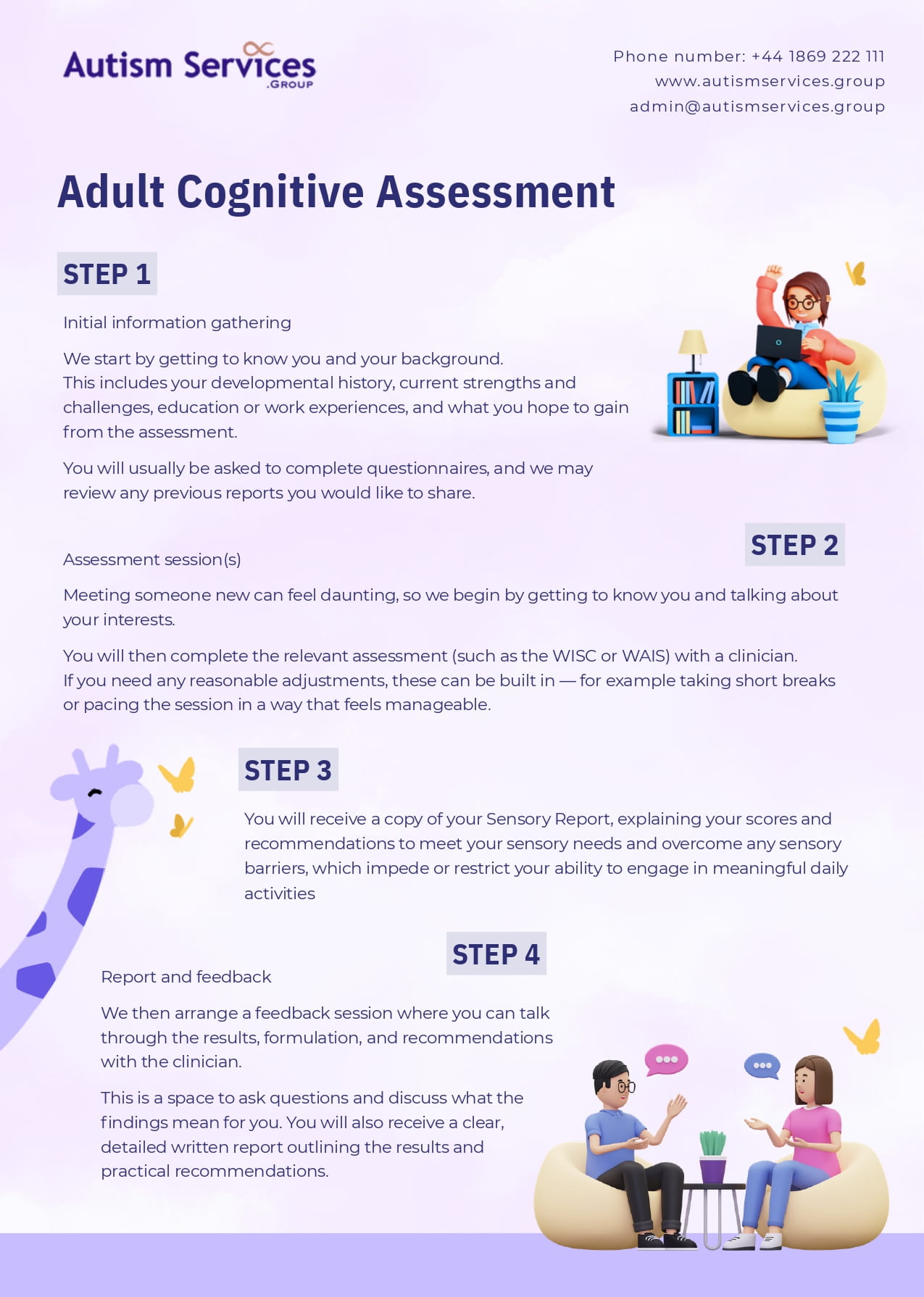
Adult Cognitive Assessment Pathway
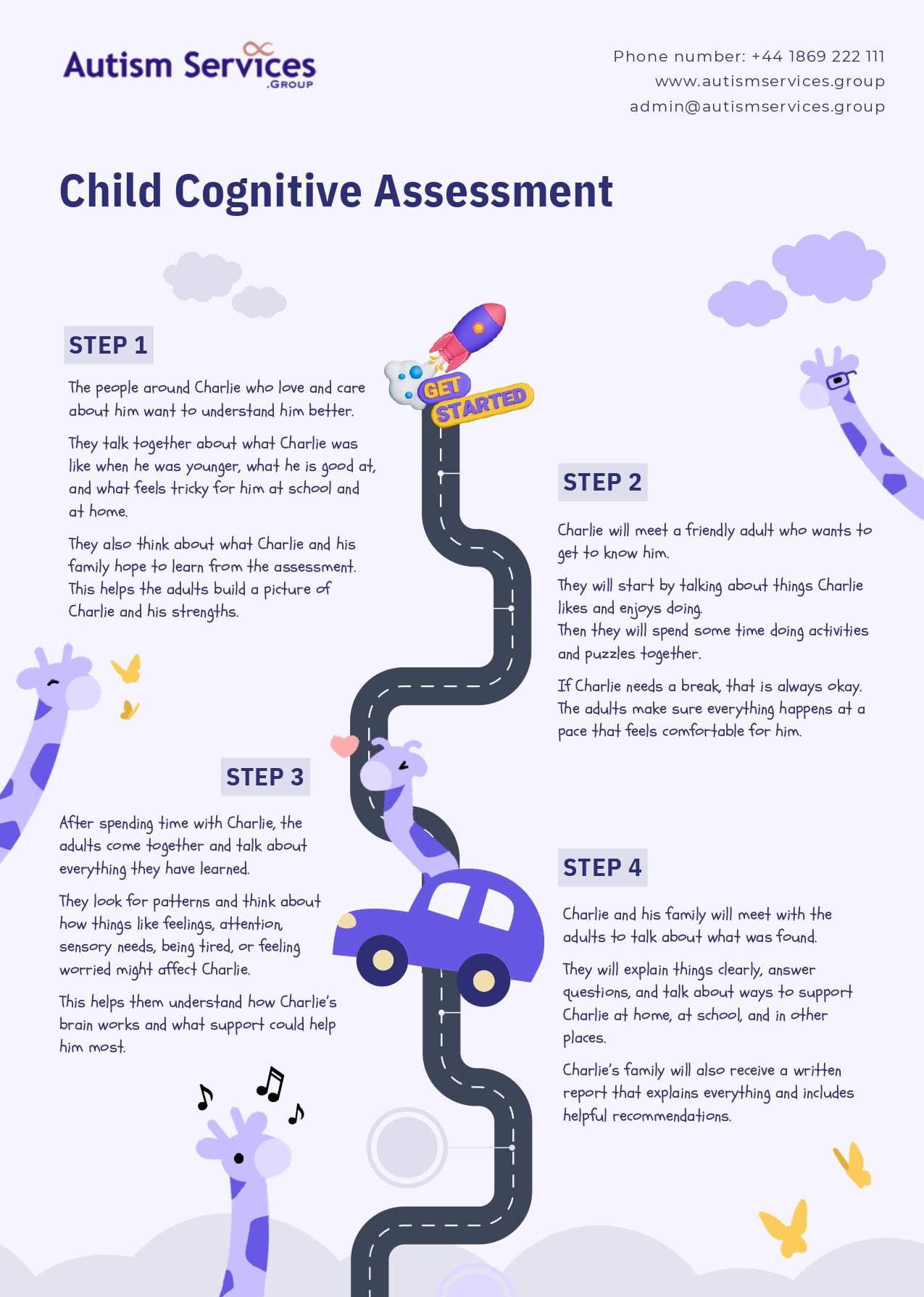
Child Cognitive Assessment Pathway
Why Families and Adults Consider a Cognitive Assessment
Families and individuals often consider a cognitive assessment when they want to further understand their child’s or own learning style and to identify if there are any specific strengths of weaknesses. People come to us often wanting clearer answers to questions such as
“Why is school or work so exhausting, even when they are trying their best?”
“Why are some tasks easy and others disproportionately hard?”
“Are expectations realistic for how they process information?”
“Do they need adjustments, support, or a different approach?”
“Do they need adjustments, support, or a different approach?”
“Could there be co-occurring learning needs alongside autism or ADHD?”
A cognitive assessment can be helpful at
many stages of life.
What a Cognitive Assessment Can Help With
A cognitive assessment can support understanding, practical planning and decision-making, including:
Clear recommendations for school, college, university, or workplace adjustments.
Targeted strategies for learning, organisation, and daily demands.
Identifying whether further assessment may be helpful (for example, academic attainment, attention, or memory).

Supporting clinical formulation when needs are complex or overlapping.
Why Autism Services Group
UK and Ireland–wide Assessments
Transparent Pricing (No added costs)
Tailored support based on location
Expert clinicians, psychiatrists, and staff
Empathetic admin team
Option of combined ADHD and Autism Assessment
Cognitive assessments
Evidence-based adult ADHD assessment
leading to support
£650 (UK)
€750 (Ireland)
What do I do with the Diagnosis
A diagnosis is not the end of the journey it is often the beginning of a better understanding of yourself, your child, or a young person.
*For adults, a diagnosis can help make sense of lifelong experiences, support self-advocacy, and provide access to reasonable adjustments in education, employment, and daily life.
*For children and young people, it can help families, schools, and professionals better understand their needs and put appropriate support in place.
Whether you are supporting a child or navigating your own diagnosis, understanding what comes next can help you make informed decisions and ensure that the right support is in place.
Our community
loves us
We’ve helped transform lives through our assessments in the UK and Ireland, with empathy and care. This is why we love what we do!
Our community loves us
We’ve helped transform lives through our assessments in the UK and Ireland, with empathy and care. This is why we love what we do!

I had a very positive experience with Autism Services Group from start to finish. I made an enquiry about an ADHD assessment and received a call back to answer any of my questions, I then booked my assessment and was guided through every step by the very helpful staff. Thank you!
Julia K.
I recently had an autism assessment and giving I was really nervous and anxious about the assessment the team were excellent, they put me at ease and the process seemed less daunting, I would highly recommend this service to anyone thinking about going for a private assessment
Caroline M.
We have used Autism Services Group for both an adult and child combined assessment of autism and ADHD. We would heartily recommend them. We have found the team responsive, empathetic, clear, concise and simply easy to interact with. The process is quite intense, but the outcomes and recommendations were incredibly helpful. We also feel the team were very balanced, thorough and evidence-based. This really helps reassure us of the quality and gives us confidence in using the recommendations and diagnosis. Thanks again!
Annie A.
From the very beginning, the communication and support from ASG before the appointment were fantastic — the team made everything clear, organised and easy to understand, which really helped put me at ease.
I felt genuinely listened to throughout, and the assessment was carried out with care, empathy and without judgement. The conversations felt relaxed and supportive whilst still being very thorough and informative.
Rob P.
We’re here to help
To get started or understand more about your occupational therapy options, our admin team, led by Toni and Kelly, will be here to help.

Your Journey. Our Support.