
Who is Qualified to Diagnose ADHD and Autism in the UK?
In the UK, many people are waiting years for neurodevelopmental assessments, and there is rising demand for mental health, ADHD and autism services worldwide. As a result, many clinicians are asking: “Who exactly can carry out assessments for ADHD and autism?” Read our guide now.
What guidelines exist on ADHD and Autism Assessments
The National Institute for Health and Care Excellence (NICE) are the governing body responsible for evidence-based recommendations that guide health and social care.
NICE guidelines are the national standards on how ADHD and autism assessments should be carried out so diagnoses are accurate, consistent and recognised by NHS services.
NICE Guidelines for ADHD assessment can be found in NG87 - ‘Attention deficit hyperactivity disorder: diagnosis and management’.
NICE Guidelines for Autism assessment can be found in:
CG128 (Autism spectrum disorder in under 19s: recognition, referral and diagnosis) - for under 19s
CG142 (Autism spectrum disorder in adults: diagnosis and management) for adults
Who can carry out ADHD and Autism Assessments?
Both guidelines for assessing for autism and ADHD emphasise a comprehensive, multi-disciplinary and people-centred approach.
Simply this means that 1) there must be a healthcare professional with specialist training and expertise in ADHD and/or autism - and 2) ADHD and autism assessments are carried out by multidisciplinary teams (MDTs) which may include specialists such as a clincal psychologist, occupational therapist (OT), speech and language therapist (SLT), social workers, psychiatrists and nurses.
How to become an ADHD and Autism Assessor
To become a neurodevelopmental assessor, you will need to take ASG’s specialist clinical training courses:
Autism Assessor – ADOS-2 / ADI-R Combined Training (5 days)
ADHD Assessor – ADHD Assessment and Management Training (2 days)
We have also written several guides on How to become an ADHD and Autism Assessor, the ‘Day in the Life’ of an ADHD Assessor, Autism Assessor and how to land a job as a newly trained assessor in a competitive job market.
Why diagnosing for ADHD and Autism is Important
At Autism Services Group, we always encourage clinicians to be competent at both autism and ADHD assessments.
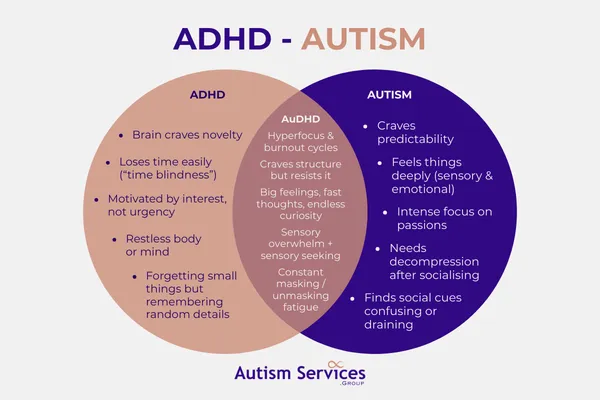
Studies say 50 to 70% of individuals diagnosed with autism also have symptoms of ADHD. Also, public interest in both ADHD and Autism are at an all-time high - hence the term ‘AuDHD’ being entered into Google Search 246,000 in January 2026.
Until DSM-5 was published in 2013, professionals couldn’t diagnose someone with both autism and ADHD simultaneously. As of today, the assessment pathways are different, and a person would have to pursue each diagnosis separately. Clinically - and in society as a whole - we’re still in the early stages of understanding what a dual diagnosis actually means. So having a more holistic view of ADHD and autism assessments (and eventually other neurotypes) is the way forward.
Takeaway
The NICE guidelines on assessing for ADHD and autism are a good point of reference that we recommend our trainees look at.
At Autism Services Group, we offer a straightforward route to assessing for ADHD and autism via our Clinical Training.