
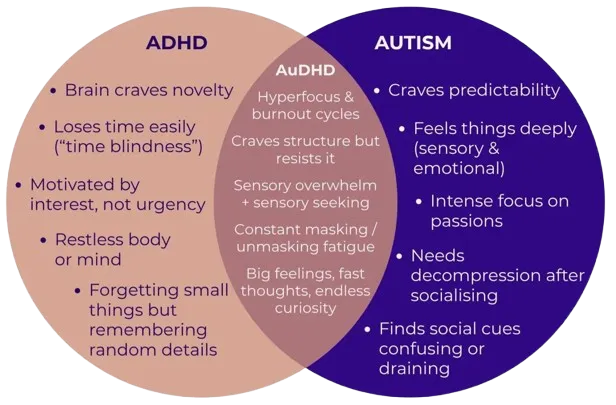
About AuDHD
AuDHD presents differently in every individual, commonly shaping how a person communicates, processes sensory information, manages attention, and experiences social interaction. Research suggests that 50-70% of autistic people also have ADHD, and the overlap between the two creates a profile that is often missed when assessed in isolation.
Here's some essential information to understand before you book an assessment with Autism Services Group.
Combined ADHD and Autism Assessment
It is very common for autism and ADHD to coexist. Individuals sometimes refer to this as being ‘AuDHD’, which means they are autistic and ADHD. Up to 70% of autistic individuals may also have ADHD, though this figure varies depending on the study (Hours et al., 2022).
Being AuDHD can often feel like an internal battle of two opposing sets of needs. For example, autistic individuals often seek structure and routine, whilst ADHD individuals strive for novelty.
This means that AuDHD may not look fully like Autism or ADHD, but this does not make the individual’s experience any less valid.
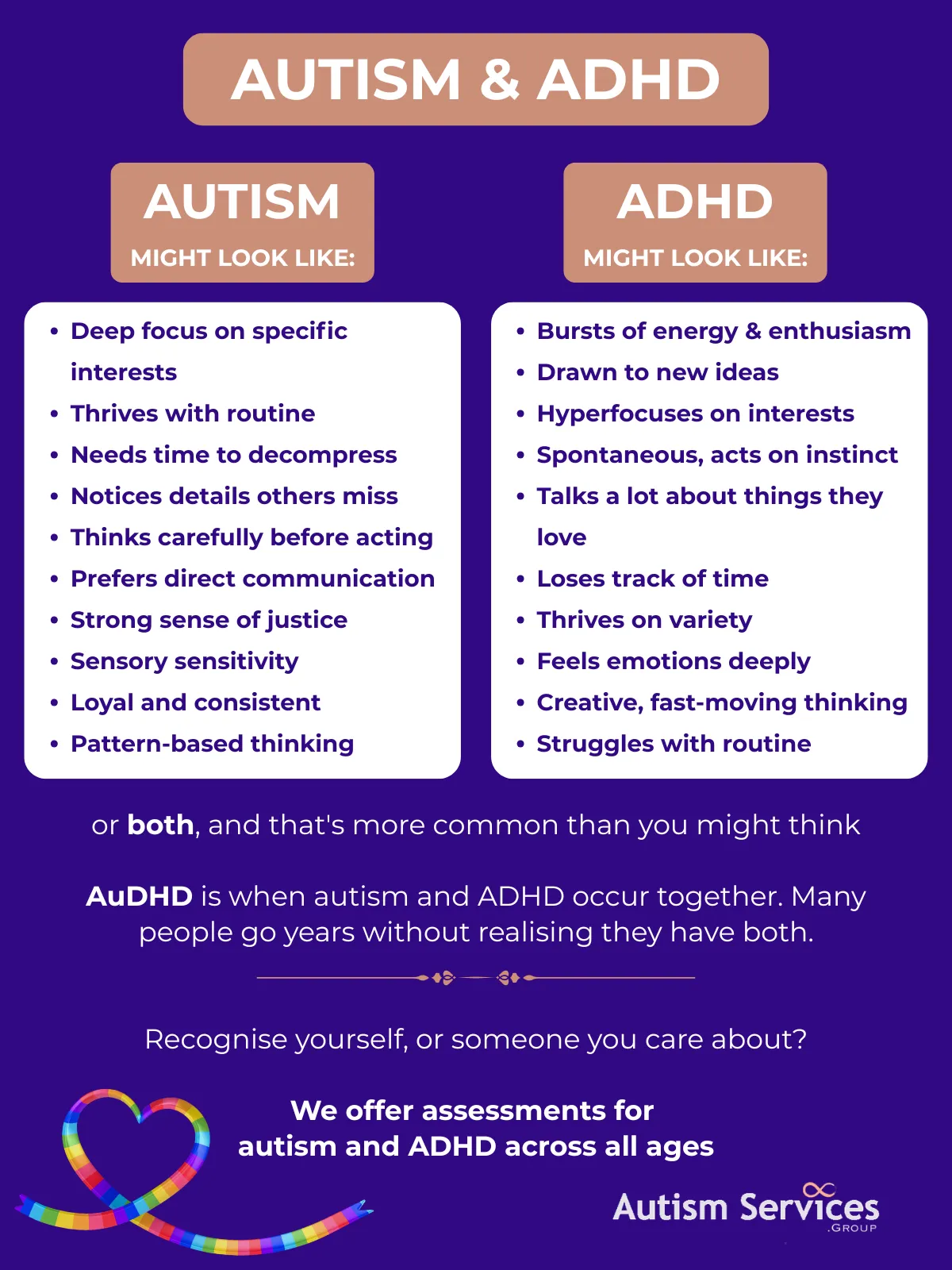
Common experiences of AuDHD individuals include, but are not limited to:
Constantly creating new routines or systems to stay on track
Living in fluctuating states of mess, overwhelm, and executive dysfunction, or becoming intensely organised to compensate for internal disorganisation.
Seeking novelty but only within familiar people, places, or processes
Making sudden decisions or changes for stimulation, then experiencing anxiety or regret once the excitement settles.
Burning out from being too busy, yet struggling to slow down
Living in cycles of chaos and overwhelm, or becoming hyper-organised to compensate
Feeling daily anxiety about lateness or timing
Having excellent long-term memory but poor working memory
Frequently shifting between intense interests
Needing stimulation (movement, noise, fidgeting) to stay regulated, while also being highly sensitive to sensory overload, resulting in overwhelm, Shutdowns, or meltdowns.
Feeling pulled between wanting to do everything at once and needing complete stillness to feel safe and regulated.
Benefits of a Combined Assessment
A combined AuDHD assessment provides a clearer, more accurate understanding of how autism and ADHD interact in your daily life.
A complete picture of your neurodivergence: Understand how autism and ADHD overlap, differ, and influence each other in your thinking, behaviour, and needs.
Clarity about your past: Make sense of lifelong patterns, challenges, and strengths that may have previously felt confusing or contradictory.
Tailored strategies that actually fit you: Learn practical ways to manage the internal push-and-pull of AuDHD, from routines and focus to sensory needs and emotional regulation.
Validation and self-understanding: Gain language for your experiences and a sense of relief in finally being seen, understood, and supported.

Ready to start your Combined Assessment Journey?
Get in touch with us if you have questions before going ahead with an assessment for yourself or your child.

Your Journey. Our Support.